The IRS is retiring FIRE after roughly forty years. IRIS replaces it with a different file format, defined in Publication 5718, and a different way in. Here is what changes, what one record looks like in both formats, and the three routes through it.
Key facts
- FIRE retires
- December 31, 2026
- IRIS mandatory
- January 2027 · TY2026 filings
- E-file threshold
- 10+ information returns · since TY2023
- IRIS Portal
- Free · manual / CSV · 100 returns per submission
- IRIS A2A
- XML (Pub 5718) · unlimited volume · needs a TCC
What is changing
FIRE accepts fixed-width text formatted to Publication 1220. IRIS accepts XML formatted to Publication 5718. Same 1099 data, a completely different file on the wire.
The catch that surprises most filers is the credential, not the format: a FIRE Transmitter Control Code does not carry over. IRIS needs its own, and the IRS says to allow up to 45 calendar days to issue one. For the shutdown dates and who has to act, read what replaces the IRS FIRE system.
FIRE and IRIS, side by side
One record, both formats
The conversion is field by field. A FIRE B record is 750 characters with every value at a fixed offset. The same payee becomes a named XML element inside a form detail block. Nothing is lost in the move, but nothing survives it untouched either.
In · FIRE B record · 750 characters
Out · IRIS XML · Publication 5718
| Field | FIRE position | IRIS element |
|---|---|---|
| Type of TIN | 11 | TINSubmittedTypeCd |
| Payee TIN | 12-20 | RecipientDetail / TIN |
| Account number | 21-40 | RecipientAccountNum |
| Payment amount 1 | 55-66 | NonemployeeCompensationAmt |
| Payment amount 4 | 91-102 | FederalIncomeTaxWithheldAmt |
| First payee name | 288-327 | BusinessNameLine1Txt |
| Payee address | 368-407 | AddressLine1Txt |
| Payee city | 448-487 | CityNm |
| Payee state | 488-489 | StateAbbreviationCd |
| Payee ZIP | 490-498 | ZIPCd |
| Second TIN notice | 544 | SecondTINNoticeInd |
| Direct sales indicator | 547 | DirectSaleAboveThresholdInd |
The mapping above is the easy half. The half that goes wrong is the money: payment amounts are keyed by Publication 1220 amount code, not by the box number printed on the paper form, and the two diverge on several forms. See the trap below.
Your three options
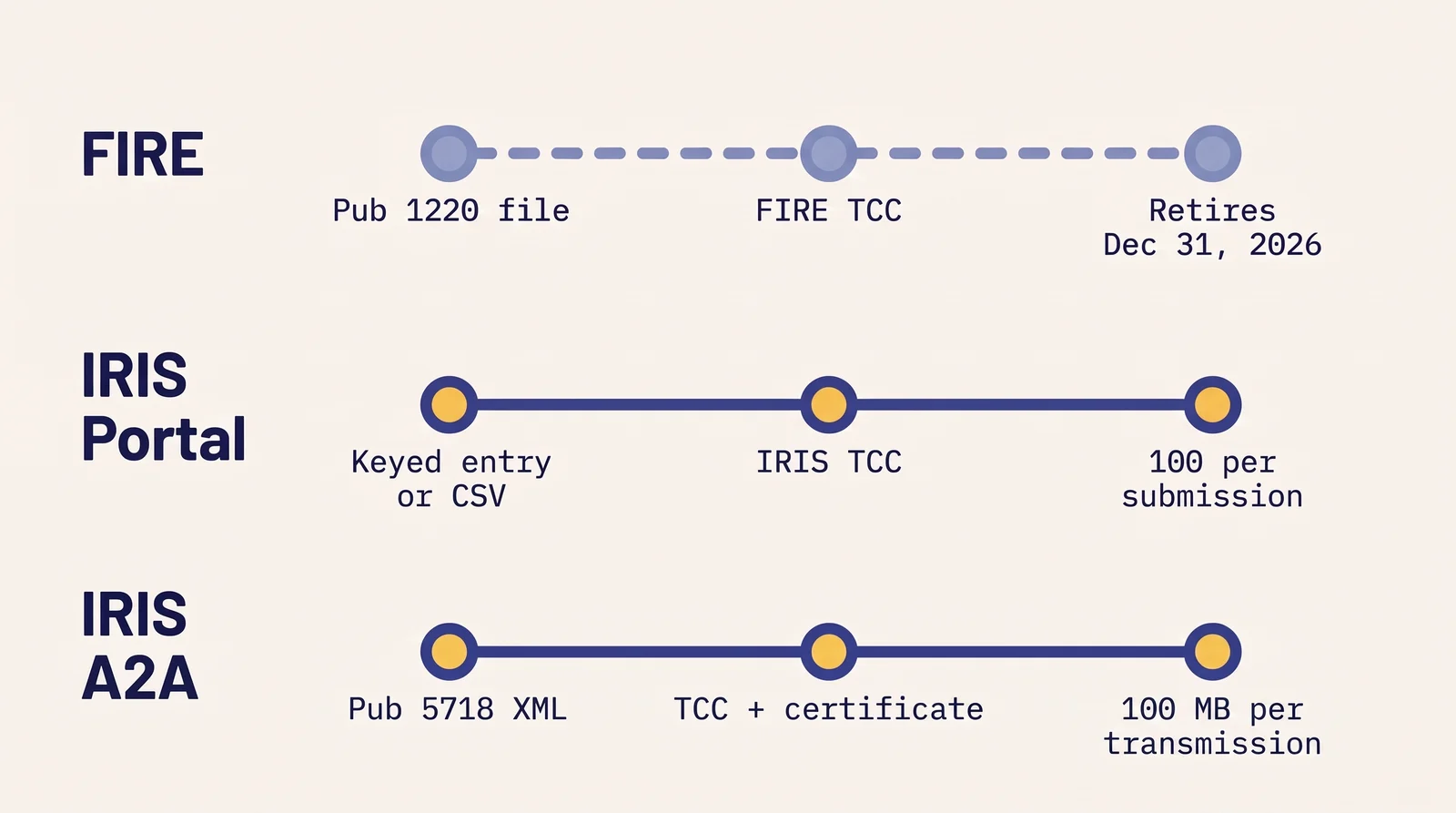
- FIRE, until it retires
- TakesA fixed-width Publication 1220 file.NeedsA FIRE TCC. New applications closed on July 21, 2026.LimitLast production file November 19, 2026 at 3 p.m. ET. The system retires December 31, 2026.
- IRIS Taxpayer Portal
- TakesKeyed entry, or the IRS CSV template.NeedsAn IRIS TCC. No software and no certificate.Limit100 returns per submission, and the work is manual every time.
- IRIS A2A
- TakesPublication 5718 XML over an authenticated API.NeedsAn IRIS TCC, an X.509 certificate, an API Client ID, and a passing assurance test.Limit100 MB per transmission, which is thousands of records. Publication 5718, section 2.
The IRIS Taxpayer Portal
Free. Manual keying or CSV upload, capped at 100 returns per submission, with no API. Workable if you file for a handful of clients and do not mind the ceiling.
Apply for your own IRIS TCC and build or buy A2A software
Full control over transmission. But the TCC application, the X.509 certificate and API onboarding, and the XML schema work are all substantial. This is a real engineering project, not a weekend.
File through a transmitter like IRISfile
Upload the FIRE, CSV, or Excel files you already produce. IRISfile converts them to IRIS XML and files under its own approved TCC. Pay per form when you file, and no schema work on your side.
Which one fits you
The right route depends less on how many returns you file than on how many separate payers you file for. Volume is a cost problem. Multiple EINs are a workflow problem, and the Portal is where that hurts.
- A solo preparer filing under 100 returns for a few clients
- The free IRIS Portal covers you. Key the returns or upload the IRIS Portal CSV template. You still need your own IRIS TCC, so apply early.
- A firm filing for 5 to 30 client EINs
- This is the hardest spot. You are over the Portal's practical ceiling, because the 100-return cap is per submission and the manual work multiplies by client. But building A2A yourself is disproportionate. A transmitter that files under its own TCC removes both problems.
- A bookkeeper who produces FIRE files from accounting software
- Your software still exports Pub 1220 fixed-width. That file is not wasted. A converter reads it and produces the IRIS XML the IRS now expects, so your existing export stays the input.
- A payroll bureau filing thousands of returns
- A2A is the only realistic route, and the schema, certificate, and testing work is a genuine engineering project. Start the TCC and API Client ID applications now, because the lead times stack.
- Anyone who already holds a FIRE TCC
- It does not carry over. IRIS requires its own TCC and a fresh application. This surprises more filers than any other part of the transition.
Timeline
- JULY 21, 2026
- The IRS stopped accepting new FIRE TCC applications.
- NOV 19, 2026
- The last FIRE production file, at 3 p.m. ET.
- DEC 18, 2026
- The last safe day to apply for an IRIS TCC: 45 calendar days before Monday, February 1, 2027.
- DEC 31, 2026
- FIRE retires.
- JAN 2027
- IRIS is the only electronic route, including prior-year returns and corrections.
- FEB 1, 2027
- 1099-NEC to recipients and to the IRS: the first hard IRIS deadline of the season. The statutory January 31 is a Sunday.
Five things that cost money if you miss them
Most transition guides stop at the format change. These are the parts that turn into rework, a late filing, or a return that is accepted and still wrong.
A rejected A2A transmission cannot be replaced
Publication 5718 for processing year 2026 is explicit. A transmission rejected for XML schema validation errors still receives a ReceiptId, but you cannot use the normal replacement process. You must refile it as a new Original, with a new filing date. If that happens near January 31, the new date is the one that counts. Validate against the schema before you transmit, not after.
Your amount codes are not box numbers
This is the single most common conversion error, and it is silent. In Publication 1220 the payment amounts in a B record are keyed by payment amount code, running 1 to 9 then A to J, with I skipped. Those codes are not the box numbers printed on the paper form, and the two diverge sharply on some forms. On a 1099-DIV, federal income tax withheld is box 4 on paper but amount code A in the file. Map by code, never by box, or dollars land in the wrong IRS element and the return still passes as well formed. The 1099 amount-code lookup tables every code against its paper box and IRIS element for all seven forms.
The TCC queue outlasts your planning window
The IRS says to allow up to 45 calendar days to process an IRIS TCC application, which requires ID.me identity verification and names two Responsible Officials. Counting back from Monday, February 1, 2027 puts the last safe application on Friday, December 18, 2026. Our TCC walkthrough covers the form and what still stands between an approved code and a filed return.
The 2027 filing season uses schemas that are not published yet
Returns filed in January 2027 are tax-year 2026 returns, and they use the TY2026 schemas. Those arrive later than the tooling built against TY2025. If a vendor tells you they are ready today, ask which tax year their schema targets.
The 1099-NEC and 1099-MISC thresholds change for TY2026
Recent legislation raises the general 1099-NEC and 1099-MISC reporting threshold from $600 to $2,000 beginning with tax year 2026. Two caveats matter more than the headline. Filing below the threshold stays legal and is often still the right call. And many states did not conform, so a return you skip federally may still be required by a state. Treat a threshold as a floor for what you must file, not a ceiling on what you may.
What to do now
Decide which of the three routes you are taking, and decide it before November. Every route except the transmitter route has a lead time you cannot compress, and the TCC queue is the longest part of it.
Then check the file you already produce. If your accounting or payroll software exports a Pub 1220 file, that export is the input to every conversion path, so an error in it becomes an error in the IRIS XML. Our free FIRE file validator checks structure, TINs, ZIPs, state codes, and amount codes in your browser. Nothing is uploaded and there is no signup.
The format change is documented in the Publication 5718 guide.
Questions
- Do I need a new TCC for IRIS?
- Yes, if you transmit to the IRS yourself. The IRIS TCC is separate from your FIRE one and does not carry over. No, if you file through a transmitter like IRISfile, which files under its own approved TCC on your behalf.
- Can I still upload my FIRE-format files somewhere?
- Not to the IRS after December 31, 2026, when FIRE stops accepting them. But converters like IRISfile still accept Pub 1220 fixed-width files as input and turn them into the IRIS XML the IRS now expects, so the file you already produce is not wasted.
- What if I file fewer than 100 returns?
- The IRIS Portal is free and adequate: manual keying or CSV upload under the 100-return cap. Below that cap, a paid service saves you keying time, not IRS fees.
- What forms does IRIS support?
- IRIS supports the full information-return catalog. IRISfile converts and validates the seven highest-volume 1099 types (NEC, MISC, INT, DIV, R, B, and S) and files 1099-NEC, MISC, INT, DIV, and R. 1099-B and 1099-S filing is on the launch roadmap for the 2027 season.
- Is the 100-return IRIS Portal cap per submission or per year?
- Per submission. You can send more than one submission, but the work is manual each time, which is what makes the Portal impractical once you are filing for many clients.
- Can I correct a 2025 return after FIRE shuts down?
- Yes, through IRIS. From January 1, 2027 IRIS is the only IRS system for electronically filed information returns, including prior-year returns and corrections.
- How do I check whether my current FIRE file is clean?
- Run it through a Publication 1220 validator before the season starts. IRISfile offers a free one that checks structure, TINs, ZIPs, state codes, and amount codes in your browser, without uploading the file.
See us more often in Google
Add IRISfile as a preferred source in your Google account. Google is then more likely to show our guides in your Top Stories and can badge them in AI Mode and AI Overviews.